


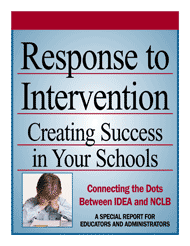


Special Executive Report
Response to Intervention: Creating Success in Your Schools
Response to Intervention (RTI) is proven to increase learning and reduce behavioral problems in at-risk students by helping teachers, Special Ed. personnel and parents collaborate. Working with a strong RTI program allows you to provide research-based assistance to every student and make a real difference. How do you put an effective RTI model in place?
| The Solution: | "Response to Intervention: Creating Success in Your Schools" |
RTI Guidelines in 30 minutes:
- Are they at-risk? Clues and leading indicators to watch for
- What the law requires: IDEA and NCLB procedures
- Sample three-tier RTI model you can customize for your school
- Roles of individual educators and parents in the RTI process
- Handling the "Can't do" and "Won't do" students
Jammed with up-to-date requirements, guidelines, and examples, this fast-read executive report gives you actionable tactics you can use today to implement an effective response to intervention model in your school.
In this concise report:
- 5 proven ways to develop an effective Response to Intervention strategy
- Academic struggles or behavior issues: Finding the difference
- The 6 core players on a Response to Intervention team
- 4 steps that define the need for Special Education
- Examples of assistive technology to use in general education
"Response to Intervention: Creating Success in Your Schools" is a clear and complete guide that walks you through every step in the RTI process. You'll be able to effectively identify at-risk students, respond with researched-based interventions, and comply with IDEA and NCLB.
Discover:
- How to communicate with parents to avoid conflict and legal liability
- RTI and IDEA compliance: What educators need to know
- Strategies to effectively help students with emotional trauma
- Severe discrepancy — how to define and identify it